


Summary
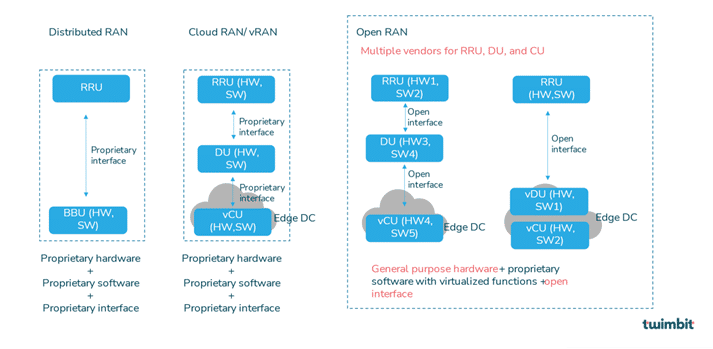
Open RAN is reshaping how mobile network operators build and manage radio access networks, moving away from single-vendor, proprietary hardware toward a disaggregated architecture built on distributed units (DU), centralised units (CU), and open fronthaul interfaces. By decoupling software from hardware—a shift often called virtualisation—operators gain the flexibility to mix and match equipment from multiple vendors rather than being locked into one supplier's ecosystem.
The architecture rests on a defined set of building blocks: the O-RU handling radio frequency processing, the O-CU and O-DU splitting protocol functions, an O-Cloud computing layer, and Radio Intelligence Controllers (RIC) that manage optimisation in near-real time and non-real time through xApps and rApps. A Service Management and Orchestration (SMO) layer ties these elements together into a single manageable domain.
Operators are drawn to Open RAN for three connected reasons: vendor flexibility that breaks proprietary lock-in, lower total cost of ownership through general-purpose hardware, and faster time-to-market for new network features. Government funding programmes in markets including the United States, United Kingdom, and India are accelerating adoption, particularly for extending mobile coverage into rural and underserved areas.
- Growth drivers include the shift toward split and virtualised 5G architectures and the commoditisation of radio hardware
- Adoption faces real friction around multi-vendor interoperability, legacy network compatibility, and consistent performance across equipment from different suppliers
As trials give way to commercial rollouts, the real question facing operators is how quickly a fragmented multi-vendor ecosystem can mature into a dependable, interoperable alternative to traditional RAN.
Schedule a call with Twimbit analyst to learn how we can help you.
Already a Twimbit client? Log in